The lace room
Through previously unseen pieces, recently acquired or specially retrieved from storage, you will plunge into the extraordinary history of Brussels lace. A fabric that has since disappeared.
Lace is an openwork fabric made with a needle or bobbins. The motifs are connected to each other by a background of stripes or mesh. Initially, it was made by hand and later it was mechanised. Lace is distinguished by its techniques, materials, motifs, colours, etc. Most of the time, it is the place where they were first produced that identifies them: Brussels, Malines, Valenciennes, Bruges, and so on.
- Brussels lace has gained international renown over the centuries. Its finesse, quality and beauty made it the preferred textile of the elites from the 17th century. It found its way to the greatest royal courts of Europe, adorning the apparel of both men and women.
- In the 19th century, lace became more democratic and widespread thanks to mechanisation. The price of fabric fell. Lace then conquered women’s fashion. Remarkable pieces were made in unprecedented large sizes, lace became a garment.
- This mechanisation marked the end of handmade lace. Brussels lace disappears with the First World War.
An overview of the museum’s lace collections
The museum’s lace collections are an integral part of Brussels’ heritage. Several of the exhibits are included in the inventory of the movable heritage of the Brussels-Capital Region. For example, check out this handkerchief decorated in the typical style of the Napoleon III era; its scalloped edges are composed of alternating leaves and flowers
To learn more, explore our various publications about the Lace Room

To be seen in the Lace Room
New display: 12.11.2025 > 12.10.2027
The Fashion & Lace Museum turns the spotlight on the outstanding heritage of Brussels lace.
In the interests of proper conservation, the museum renews its lace display every two years. Rotating the pieces on view in this way makes it possible to both conserve the oldest and most fragile items and offer visitors the opportunity to admire examples of superb lacework. The museum also presents its recent lace acquisitions, pieces which have rarely, if ever, been exhibited.
Now in the Lace Room
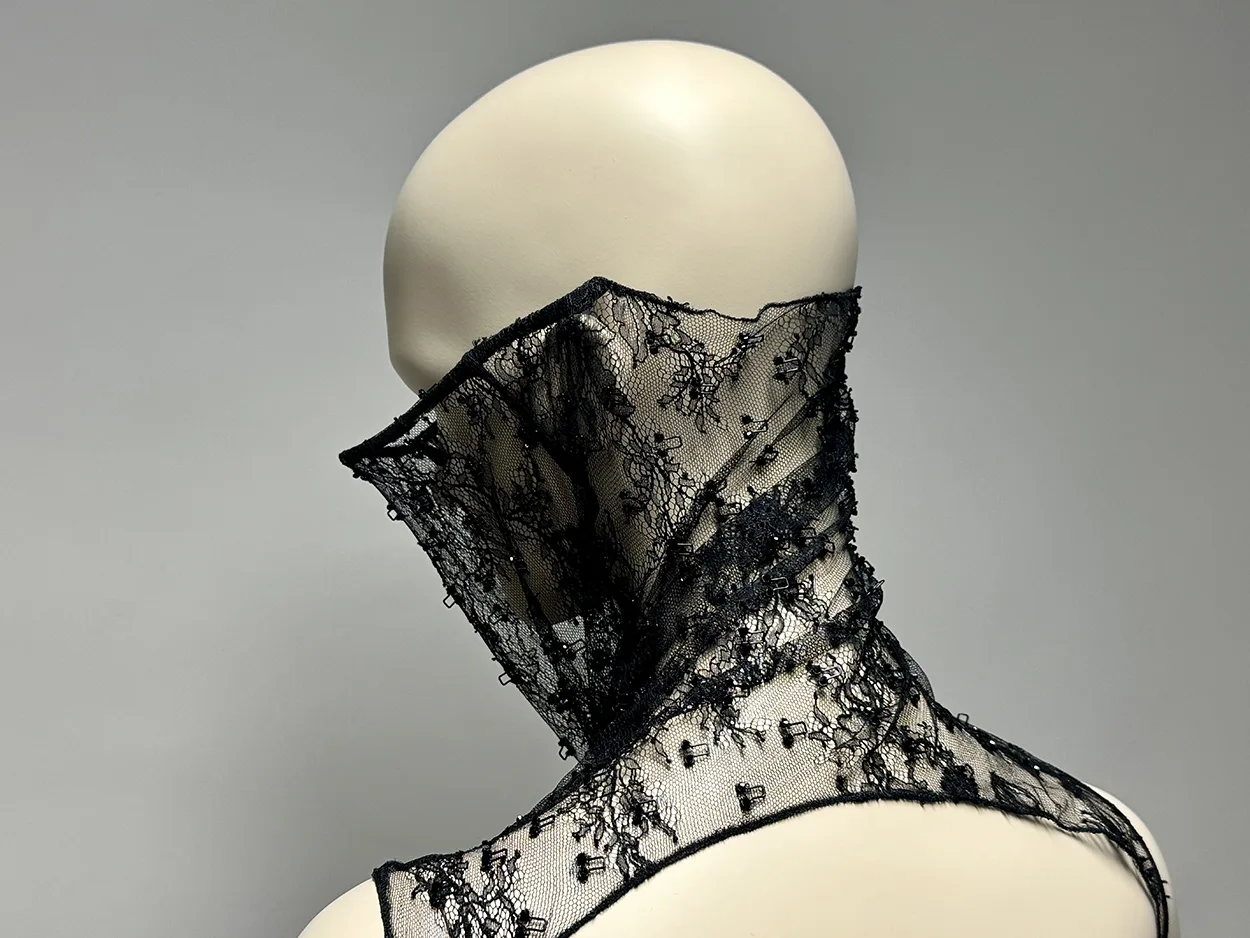
Ensemble, Nicolas Di Felice for Jean Paul Gaultier, Autumn-Winter 2024 Haute Couture Collection
For the first time, the Fashion & Lace Museum presents an exceptional ensemble designed by Nicolas Di Felice for Jean Paul Gaultier in its new panorama display. Part of the Autumn-Winter 2024 Haute Couture Collection , it comprises a dress, briefs, a bodysuit, boots and lace samples, and highlights the essential role of lace in contemporary fashion.
This addition marks a new direction in the museum’s acquisition policy: the use and reinterpretation of lace by today’s fashion designers. At the crossroads of the museum’s contemporary fashion and lace collections, this silhouette demonstrates how historic craftsmanship continues to inspire present-day creation.
The choice of this particular ensemble is significant. Born in Wallonia and trained in Brussels, Nicolas Di Felice has established himself as one of the leading figures of contemporary Belgian fashion. This silhouette, created for the House of Jean Paul Gaultier, explores the notions of revealing and concealing. Lace therefore plays a central role in the design.
The Fashion & Lace Museum pays particular attention to the ways Belgian and Brussels-based designers use lace in their creations. This acquisition perfectly illustrates the use of machine-made lace in contemporary fashion and underscores the importance of this textile heritage in today’s fashion landscape.
The lace season
For one season per year, the Fashion & Lace Museum joins forces with the Museum of Art & History to show the public some of the main items in the lace collections of the two institutions.
The latest Season
All Lace Seasons


Utiliser flèches haut et bas pour redimensionner le panneau de la boîte méta.
Utiliser flèches haut et bas pour redimensionner le panneau de la boîte méta.